
What Is Accrual Accounting for HOAs?
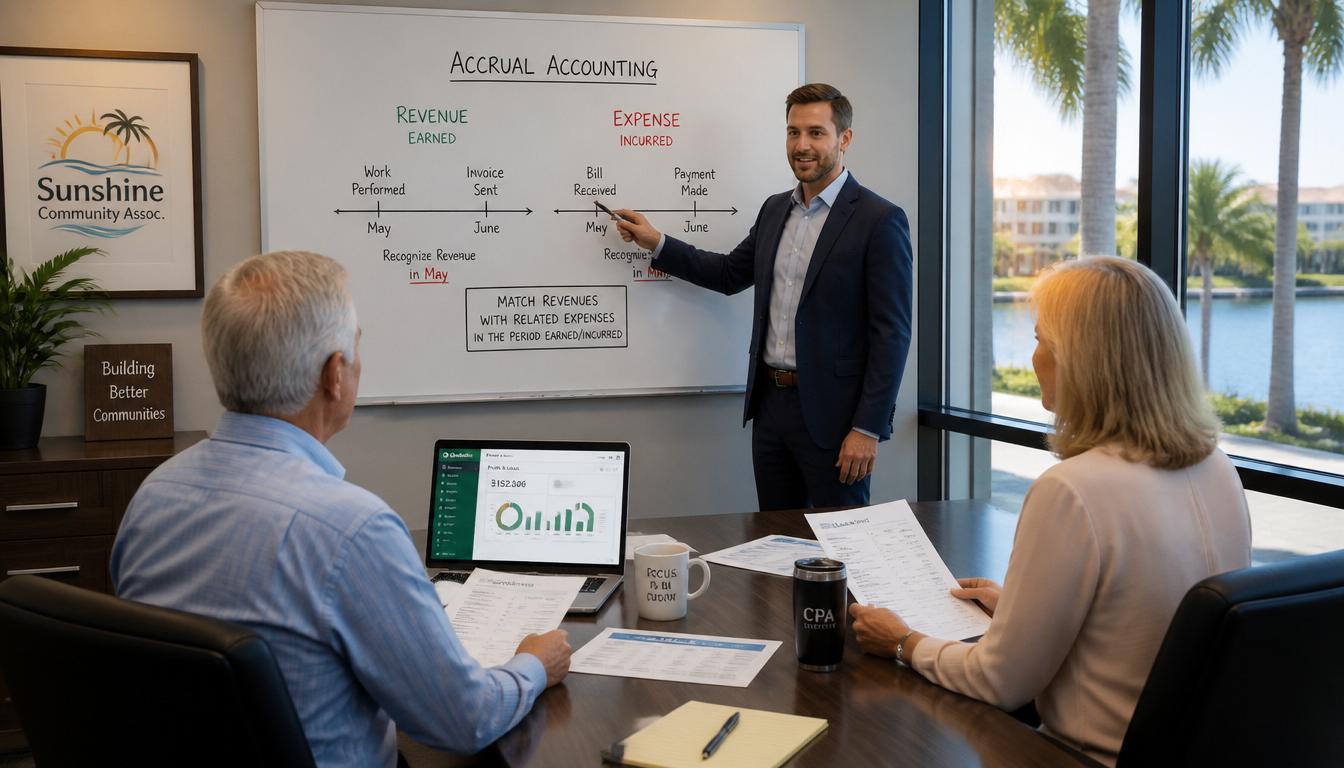
Florida community associations operate within a specific accounting framework that shapes how transactions are recorded. Accrual accounting for hoas requires associations to record revenues when earned and expenses when incurred, regardless of when cash moves.
Chapter 720 of the Florida Statutes does not mandate a specific accounting method for homeowners associations. However, accrual accounting produces more accurate financial statements than cash-basis accounting for community associations. Therefore, boards and CPAs who understand this distinction make better-informed financial decisions.
Defining Accrual Accounting for HOAs
Accrual accounting records financial transactions based on when they occur economically, not when cash moves. Revenue posts when it becomes owed, not when the owner pays. Expenses post when incurred, not when the vendor gets paid. Furthermore, this method produces financial statements that reflect the true financial position of the association at any given moment.
Cash-basis accounting, by contrast, records only transactions where cash has actually moved. Many smaller associations start with cash-basis accounting because of its simplicity. Consequently, boards that transition to accrual accounting often discover a more accurate and complete picture of their financial health.
Revenue Recording Under Accrual Accounting for HOAs
Under this method, assessment income posts to the books on the date it becomes due. Recording revenue at the start of each period, rather than at collection, gives boards real-time visibility into receivables. Furthermore, outstanding assessments appear on the balance sheet immediately as accounts receivable.
Boards can see total receivables, identify delinquent accounts, and assess collection performance accurately at any time. Revenue figures on the income statement reflect what was earned during the period, not just what was collected. Moreover, this precision supports more reliable budget comparisons and financial planning throughout the year.
Expense Recording and the Matching Principle
Expenses post under accrual accounting when the association incurs the obligation, not when payment leaves the bank. A vendor invoice received in December posts as a December expense even if payment occurs in January. Therefore, financial statements prepared this way match expenses to the period they actually belong to.
This matching principle provides clearer insight into the true cost of operating the community in any given period. Boards reviewing accrual-based statements see a more accurate comparison between actual expenses and the approved budget. Additionally, auditors and CPAs strongly prefer accrual accounting because it conforms to generally accepted accounting principles.
Reserve Fund Accounting Under Accrual Methods
Reserve fund transactions also follow accrual principles in well-managed associations. Monthly reserve contributions post as expenses in the period they are designated, regardless of when funds transfer between accounts. Furthermore, reserve expenditures post when the association commits to the repair, providing earlier visibility into reserve fund activity.
Proper tracking under accrual accounting for hoas ensures financial statements reflect the full cost of operating and maintaining the community. Boards that monitor reserve activity accurately can identify funding shortfalls earlier. Consequently, proactive reserve management reduces the risk of unexpected special assessments.
Accrual Accounting and Financial Statement Accuracy
Accrual-based balance sheets and income statements more accurately reflect the association’s financial reality. Assets include all amounts owed to the association, not just cash on hand. Liabilities include all obligations incurred, not just bills already paid. Therefore, every financial decision the board makes rests on a more complete and reliable financial picture.
CPAs who audit or review association finances expect accrual-based records. Associations that maintain this method experience smoother audits and fewer adjusting entries. Similarly, lenders and regulatory bodies find accrual statements easier to interpret and more credible overall.
Software That Supports Accrual Accounting for HOAs
Purpose-built association management software significantly simplifies accrual accounting for hoas. Automated assessment billing posts revenue to the correct period automatically. Accounts payable workflows capture expense obligations as soon as invoices arrive. Furthermore, integrated reporting generates accrual-based balance sheets, income statements, and budget comparisons without manual adjustments.
Real-time financial dashboards give boards instant visibility into earned revenue, outstanding receivables, and unpaid obligations. Above all, purpose-built software ensures every transaction posts to the correct period and account, eliminating errors that generic tools allow.
Steps for Achieving Goal
- Confirm with your CPA whether the association currently uses accrual or cash-basis accounting and document the method in writing.
- Establish a policy that all assessment revenue posts on its due date as a receivable, regardless of collection timing.
- Require that all vendor invoices post to the accounts payable ledger immediately upon receipt before any payment is processed.
- Review financial statements monthly to confirm that revenues and expenses appear in the correct reporting period.
- Work with your CPA to convert to full accrual accounting if the association currently uses cash-basis methods.
- Adopt purpose-built software that automates accrual-based posting for assessments, payables, and reserve contributions.
- Present accrual-based financial statements at every board meeting to ensure all decisions rest on accurate financial data.
Key Takeaways
- Accrual accounting for hoas records revenues when earned and expenses when incurred, regardless of cash movement timing.
- Assessment revenue posts on its due date under this method, creating immediate accounts receivable visibility for boards.
- Expenses post when incurred, matching costs to the period in which the association actually benefited from the service.
- Accrual-based financial statements provide a more accurate picture of association finances than cash-basis alternatives.
- CPAs and auditors strongly prefer accrual accounting because it conforms to generally accepted accounting principles.
- Reserve fund transactions also follow accrual principles, providing earlier visibility into reserve activity and funding gaps.
- Purpose-built software automates accrual-based posting and generates accurate financial statements without manual adjustments.
Conclusion
Every Florida community association benefits from understanding and applying this accounting method in its financial operations. Boards that adopt it gain a clearer view of financial health at every point in the fiscal year.
Strong accrual accounting practices do more than satisfy professional standards. Above all, they give boards the financial clarity needed to govern effectively and protect every owner’s investment. Therefore, associations that commit to accrual accounting position themselves for stronger financial reporting and greater stakeholder confidence.
The information provided on this website is NOT to be considered legal advice. Associations and unit owners should consult with legal counsel for the specific application of the Association’s governing documents and Florida Statutes.