
How Does HOA Assessment Collection Accounting Work?
Florida community associations depend on consistent assessment income to fund every operational and reserve obligation they carry. Hoa assessment collection accounting governs how every dollar collected from owners gets recorded, applied, and reported accurately.
Chapter 720 of the Florida Statutes requires associations to maintain financial records that accurately reflect every assessment transaction. Boards that understand this process protect their communities from accounting errors and legal exposure. Therefore, disciplined assessment collection accounting is a non-negotiable operational requirement for every Florida association.
Defining Hoa Assessment Collection Accounting
Collection accounting refers to the complete financial process of billing, receiving, posting, and reporting owner assessment payments. Every step in that process must follow consistent procedures aligned with the association’s governing documents. Furthermore, each transaction must post to the correct owner ledger immediately upon receipt.
The process begins before a payment ever arrives. Hoa assessment collection accounting requires that every assessment be recorded as a receivable on its due date. Posting on the due date rather than the payment date keeps financial records accurate. Consequently, financial statements reflect what is truly owed at any given moment.
How Assessments Are Billed and Posted
Billing involves generating and delivering assessment notices to every owner according to the schedule defined in the governing documents. Most associations bill monthly, quarterly, or annually. Furthermore, each invoice must reflect the correct amount, due date, and any applicable late fee schedule.
Posting payments requires applying each dollar received to the correct owner account in the correct order. Most governing documents require payments to apply to delinquency fees first, then interest, then late fees, and finally to the oldest outstanding balance. Boards that post payments incorrectly create accounting errors that compound quickly over time.
Statutory Requirements Affecting Assessment Accounting
Section 720.303 of the Florida Statutes establishes specific requirements for how associations collect and account for assessments. Associations must maintain records of every assessment levied, every payment received, and every outstanding balance. Therefore, the accounting system must capture complete transaction histories for every owner account.
Additionally, associations must produce accurate financial reports reflecting total assessments billed, total collected, and total outstanding. These reports support board decision making and satisfy statutory disclosure obligations to members. Boards that maintain clean assessment records fulfill both operational and compliance responsibilities simultaneously.
Late Fees, Interest, and Delinquency Tracking
Beyond collecting on-time payments, hoa assessment collection accounting requires tracking every delinquent account carefully. Every delinquent account generates late fees and interest that must be calculated and posted accurately. Furthermore, those amounts must follow the rates and procedures defined in the governing documents and Florida law.
Organized delinquency records support every step of the collections process, from initial notice through lien filing if necessary. Real-time visibility into which accounts are current and which are past due strengthens timely collections action. Consequently, clean assessment accounting directly strengthens the association’s ability to recover unpaid balances.
Connecting Assessment Accounting to Financial Statements
Receivable balances flow directly from assessment collection data onto the balance sheet as current assets. Collected assessment income appears as the primary revenue line on the income statement and profit and loss report. Moreover, any errors in collection posting create corresponding errors in every downstream report.
Clean, accurate collection records therefore improve the reliability of every financial report produced. Boards that maintain organized records build a stronger financial reporting foundation for the entire organization. Similarly, CPAs and auditors complete their work faster when collection data is well organized.
Technology That Improves Assessment Collection Accounting
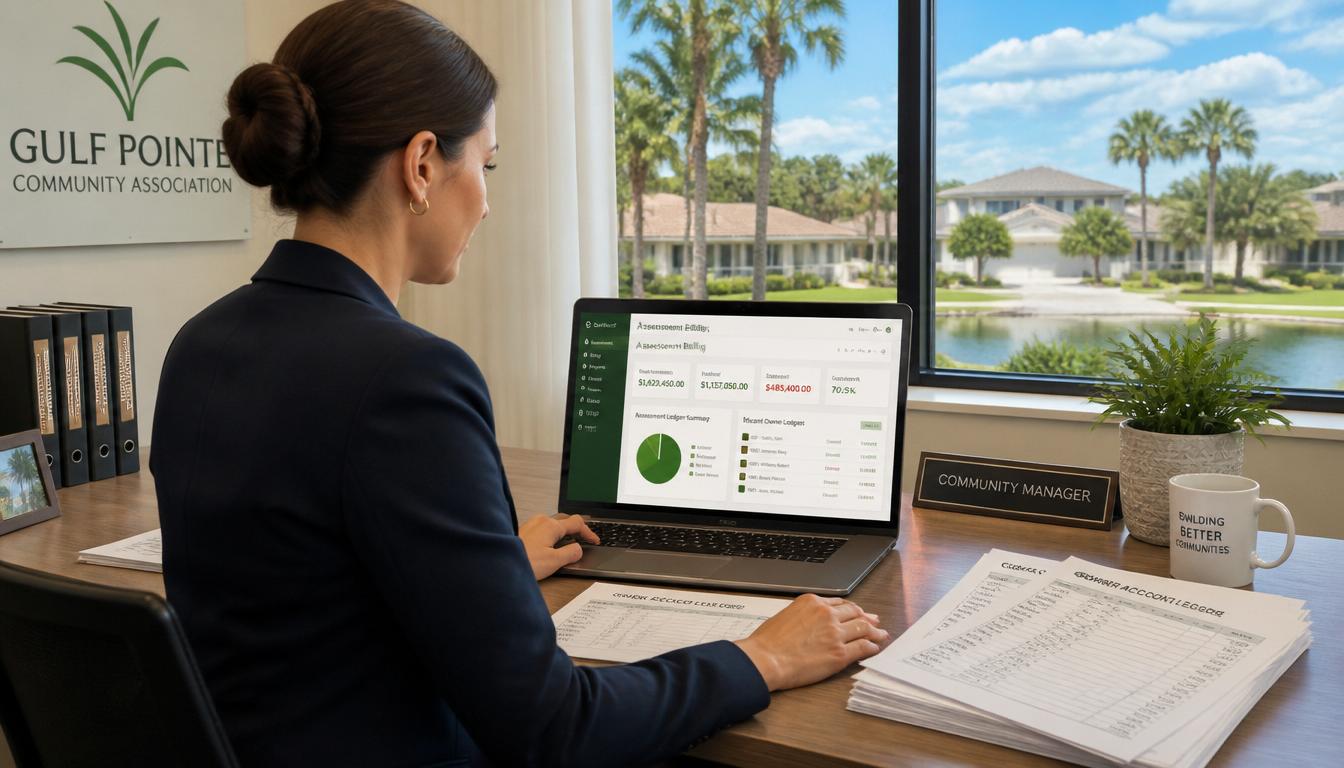
Purpose-built software transforms how associations manage hoa assessment collection accounting. Automated billing generates and delivers assessment notices on schedule without manual intervention. Payment posting applies incoming funds to the correct account and ledger line automatically. Furthermore, integrated delinquency tracking flags overdue accounts in real time.
Real-time reporting gives boards instant visibility into total assessments billed, collected, and outstanding. They can identify collection trends early and intervene before delinquencies escalate. Above all, organized digital records eliminate the errors that manual systems inevitably produce over time.
Steps for Achieving Goal
- Establish a written assessment collection policy that defines billing schedules, due dates, late fee amounts, and payment application order.
- Post every assessment as a receivable on its due date regardless of when the owner actually submits payment.
- Apply every incoming payment in the correct statutory order, addressing fees and interest before applying to outstanding assessments.
- Generate aging reports monthly to identify delinquent accounts and prioritize collection follow-up accordingly.
- Reconcile total assessments billed against total collected and total outstanding at the close of every reporting period.
- Adopt purpose-built software that automates billing, payment posting, delinquency tracking, and financial reporting.
- Review assessment collection data at every board meeting to maintain oversight and make informed financial decisions.
Key Takeaways
- Hoa assessment collection accounting governs how every dollar collected from owners gets recorded, applied, and reported.
- Florida Statute 720 requires associations to maintain complete records of every assessment levied, received, and outstanding.
- Assessments must post as receivables on their due date to ensure financial records reflect an accurate picture at all times.
- Payments must apply in the correct statutory order to prevent accounting errors that compound over time.
- Delinquency tracking requires real-time visibility into account status to support timely and compliant collections action.
- Accurate assessment accounting improves the reliability of every downstream financial report the association produces.
- Purpose-built software automates billing, posting, and reporting while eliminating errors that manual processes create.
Conclusion
Every Florida community association depends on accurate hoa assessment collection accounting to maintain financial stability and statutory compliance. Boards that prioritize this process protect their communities from accounting errors, collections failures, and owner disputes.
Strong assessment accounting does more than track payments. Above all, it creates the financial foundation every board needs to govern effectively and report accurately. Therefore, associations that invest in disciplined collection accounting position themselves for stronger financial health and greater statutory confidence.
The information provided on this website is NOT to be considered legal advice. Associations and unit owners should consult with legal counsel for the specific application of the Association’s governing documents and Florida Statutes.